2026-08-24•Technical
Introduction
What if you could ask an AI assistant to run a test suite, explain a failing scenario, or summarize a complex error log in plain English without changing your existing test automation framework?
Modern automation frameworks such as Pytest and Playwright are incredibly powerful, but they’re often designed with technical users in mind. Running tests, configuring execution parameters, and investigating failures can require considerable framework knowledge, especially as projects grow in size and complexity.
I wanted to explore whether AI could make those workflows more accessible without compromising the flexibility and reliability of the underlying framework.
The result was a proof-of-concept architecture that combines Pytest, Playwright, and the Model Context Protocol (MCP). By introducing a lightweight MCP layer, both technical and non-technical users can interact with a test automation framework using natural language, while the framework itself remains fully independent and capable of running through its normal CLI and CI/CD workflows.
Why I Built It
The idea originated from several recurring challenges I have encountered in test automation projects.
Challenge 1: Complex Test Execution
As automation frameworks grow, test execution commands can become increasingly complex.
A simple test run may require:
- Environment selection
- Brand or tenant configuration
- Browser settings
- Parallel execution options
- Custom pytest flags
- Report generation settings
While experienced engineers can navigate these commands, they still create friction during day-to-day work.
Challenge 2: Failure Analysis Takes Time
When an E2E test fails, the failure itself is often not the biggest problem.
The real effort comes from:
- Reviewing logs
- Reading stack traces
- Understanding screenshots
- Analyzing traces
- Identifying likely root causes
Many failures contain valuable information, but extracting that information quickly remains a challenge.
Challenge 3: Limited Accessibility for Non-Technical Stakeholders
Automated testing delivers significant business value, but access to that value is often limited to engineering teams. Product owners, business analysts, support teams, and other stakeholders frequently need answers to questions such as:
- Did this user journey still work?
- Can we execute this scenario?
- What failed?
- What changed?
Traditional test automation tooling is not designed with these users in mind.
The Goal
The primary objective was not to replace Pytest or Playwright.
Instead, I wanted to:
- Keep the automation framework fully independent
- Preserve existing CI/CD workflows
- Add a lightweight AI interface layer
- Support both technical and non-technical users
- Explore practical MCP integrations
A key design principle was that the framework should still function perfectly without AI. The MCP layer should act as an enhancement, not a dependency.
The Architecture
For a more technical view please visit the MCP-Pytest-Blueprint Github repo.
The blueprint consists of two independent components:
1. Pytest + Playwright Framework
The automation framework remains responsible for:
- Test execution
- Browser automation
- Reporting
- Logging
- Parallel execution
- Environment management
It can still be executed entirely through the command line or CI/CD pipelines.
How to run the tests
The framework dynamically selects users, brands, and environments through configuration-driven execution, allowing a single test suite to scale across multiple brands and deployment environments.
Sequential:
uv run pytest -s tests/test_x.py
========================================
Captured Environment Name: test
Captured Brands Input:     all
Resulting List:            ['aaa', 'bbb', '...']
========================================
xdist_group_1: test_x[aaa] → test_x[bbb] → test_x[ccc] → test_x[ddd] → test_x[eee] → test_x[fff]
Parallel:
uv run pytest tests/test_x.py --env=test --brands=all -n auto --dist=loadgroup --headed
========================================
Captured Environment Name: test
Captured Brands Input:     all
Resulting List:            ['aaa', 'bbb', '...']
========================================
xdist_group_1 (abc_user): test_x[aaa] → test_x[bbb] → test_x[ccc]
xdist_group_2 (def_user): test_x[ddd] → test_x[eee] → test_x[fff]
                          └──────── run simultaneously ─────────┘
2. MCP Server Layer
The MCP server acts as a bridge between AI clients and the test framework.
This layer allows AI assistants to:
- Trigger test runs
- Filter tests
- Read reports
- Analyze failures
- Explain results
- Communicate in natural language
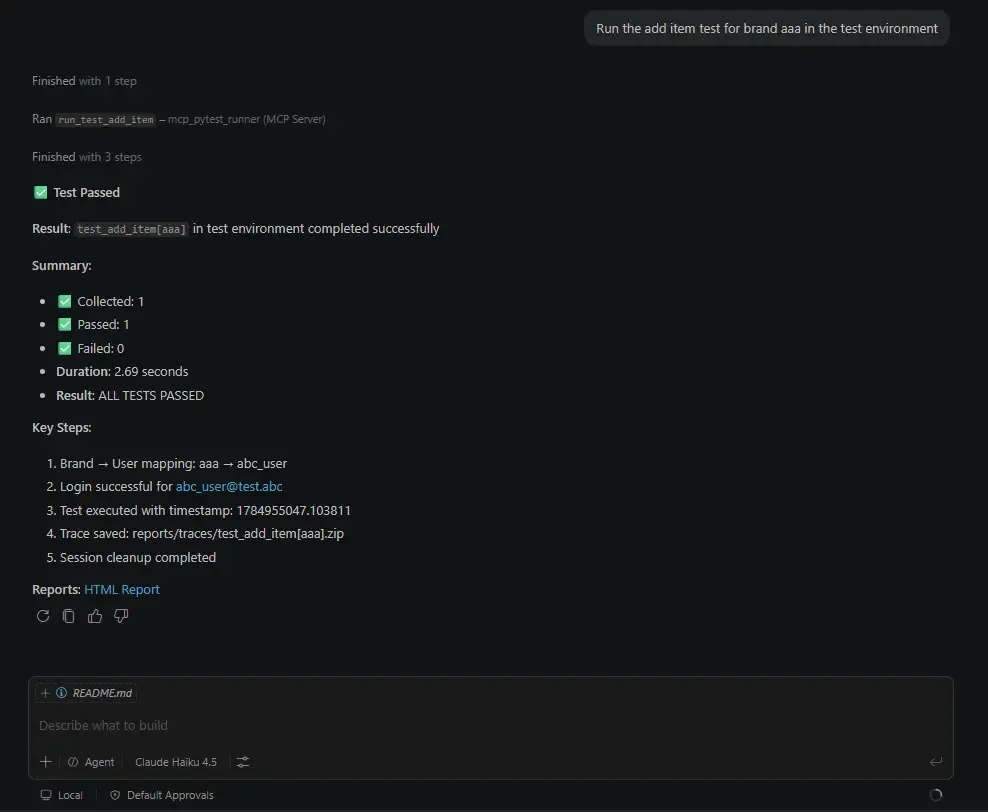
How to run the tests with a remote LLM
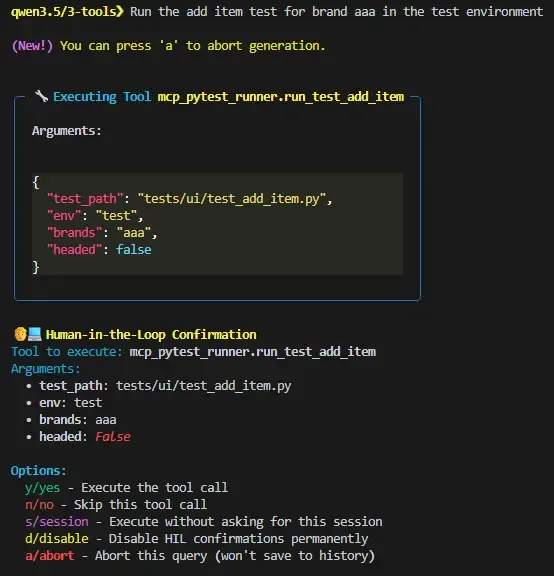
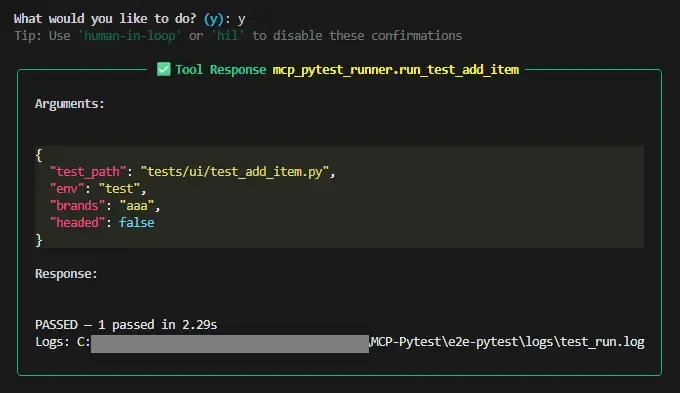
How to run the tests with a local LLM

Advantages & Considerations
Introducing an extra layer comes with both benefits and trade-offs:
Advantages
- Natural language interaction with automated tests
- Faster failure investigation and report analysis
- Reduced learning curve for non-technical stakeholders
- Improved accessibility across cross-functional teams
- Existing Pytest and CI/CD workflows remain unchanged
- Support for both local and remote LLMs
Considerations
- Introduces an additional component that must be maintained
- AI-generated explanations still require human validation
- Additional security considerations may be required in enterprise environments
- Not every project benefits from the added complexity
- MCP tooling and integrations will continue to evolve
What I Learned
MCP Is Simpler Than It Appears
Before building the project, MCP felt like a complex new technology. In reality, the protocol itself is straightforward once you understand its role as a standardized interface between AI models and tools. The real challenge lies in designing meaningful tools and workflows.
Good Documentation Matters More Than Ever
AI systems depend heavily on context. Well-documented tools, clear descriptions, and predictable outputs dramatically improve the quality of interactions. Poor documentation leads to poor AI experiences.
Existing Frameworks Still Matter
Despite the excitement surrounding AI, the strongest solutions still rely on robust underlying systems.
The Pytest and Playwright foundation remains the most important component of the architecture. AI enhances the experience but does not replace good framework design.
AI Works Best as an Assistant
The goal is not autonomous testing.
The goal is reducing friction:
- Less command memorization
- Faster debugging
- Easier reporting
- Better collaboration
Final Thoughts
This project started as an experiment. I wanted to better understand how AI technologies could be combined with quality engineering practices without disrupting the foundations that make those practices reliable.
What began as an exploration of MCP quickly became a broader lesson in accessibility, usability, and collaboration. The most valuable outcome wasn’t simply connecting an AI model to a test framework, but discovering new ways to make testing information easier to access, understand, and act upon for both technical and non-technical stakeholders.
As AI continues to evolve, I believe some of the biggest opportunities won’t come from replacing existing tools and processes, but from making them more approachable and more effective. Strong frameworks, good engineering practices, and quality-focused teams will remain essential. AI simply provides another layer that can help reduce friction and improve how people interact with technology.
This blueprint represents one step in that journey. It allowed me to deepen my understanding of MCP, explore practical AI integrations, and think differently about how quality engineering can evolve in the years ahead.
And like many good side projects, it answered a few questions while creating many new ones to explore next.
Additional Resources
Interested in learning more about this project?
Links
-
GitHub Repository
Architecture documentation, setup guide, and integration examples.
MCP-Pytest-Blueprint Github repo. -
DEV Community Article Read the public article and join the discussion.
(Coming Soon)